Team Building Activities in Pune | Taal Inc

When you are a part of a team or work with a team, there is almost always pressure under which you are working. There are deadlines that are scarily close, resources to reach the target seem like they are not enough and yet success is only measured in performance, output and efficiency.Now, to be fair, let’s try to put this team into a group activity that’s not their usual one. One, where they can connect with each other on a deeper level, where they can learn and express themselves easily. This takes away all preexisting ability-bias. This makes it easy for them to experience, identify and work on some of their impending issues and apply them at their workplace without too much effort.
team building activities in pune

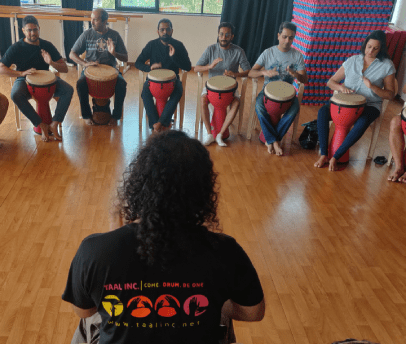
This new team building activity (whether it is Drum Circle, Dance Movement Therapy, Creative Writing or Theatre Games), will help them bond together on a totally new forum and start working more cohesively. They’ll be much more intrinsically motivated and more empathetic about each other. These are two very crucial characteristics needed when dealing with a pressuring situation. How will all this magic happen you ask? Well to start off with, it is human nature to synchronise. Take the pendulum principle as evidence thereof. In fact, when ever we feel out of sync, there is conflict or dis-ease. Group drumming helps us identify and reconnect with our very innate and natural tendency of working in a team, collaborating, synchronising with our fellow team members. Secondly, this ‘fun’ activity helps us look at ourselves with less judgement and take ourselves less seriously. Hence, when you least expect it, you will have an epiphany, like the answer was with you all along.

Once you have that connection (with yourself, others, your team at your workplace as a result of a team building activity), it’s more natural to take seemingly “difficult” tasks in your stride.

We work with organisations where we use specially designed art based interventions or activities to touch upon and elicit these desired behaviours.

A drum circle is the main activity where, as the name suggests, people sit in a circle and create rhythms together. We use theatre games, creative writing activities and through these art forms, we get into conversations or debriefs. Our pre-planned areas or objectives are explored in this process. For example a role play activity helps bring out a more genuine expression from a participant (about their lives, their problems, their work and so on) Something they might not have shared up until now. There is an open exchange of energy, of information, of trust, of vulnerability. This is what sparks deep rooted change.

Here it does not matter how good you are at drumming or dancing or acting or performing. It’s more. About using these art forms to help you communicate more authentically. It’s about being yourself. This journey of finding yourself, of finding your inner rhythm becomes very accessible and that too without consciously trying. As adults, we’ve used the cognitive pathway so much for learning that our brain literally has reduced neuroplasticity. This is the scientific reason why kids learn and unlearn much more easily than adults. Let’s take up an activity that gives our brain a good workout, shall we?

At work there are a lot of components.
There’s you (an individual)
There’s a team (your colleagues).
The above two are tied in with your usual daily work.
There’s your family circumstance that gets added to the mix and influences you
There’s also an overarching organisation that is measuring, watching and setting a context or expectations to your work.

Now we may or may not be able to change the above components so let’s keep all of them same and add a new and unique activity to tie in these components. Listen, watch and feel how the interaction quality of these components change (for the better).

While you are amidst nature, hiking, camping, taking part in an adventure sport, or yoga, it feels different, doesn’t it? You make way for realisations, don’t you? This is the Taal Inc. way to facilitate a team building activity (a process) for your whole team. It’s all about expression or as we’d say in psychology terminology, the unconscious or subconscious mind being revealed through a process involving the arts. And accessing this part of our selves influences the conscious part. This is the therapeutic value of rhythm and the arts.We will connect with your team’s culture, beliefs and value system through creative mediums and help align those of the individuals to those of the team to those of the organisation on the whole.These participative group activities organically bring out individual behaviour and as well as group influence on this behaviour. People are doing and experiencing as opposed to being told.We believe that our team building program helps people

  • Reduce stress
  • Makes them more confident
  • Makes them more cohesive
  • And more self aware

Come, experience change with a Taal Inc. Exchange session.
What are the benefits of Group Activities for Employees?

Why employee engagement activities in companies? And why not just focus on the task at hand and team it up with a good pay package?

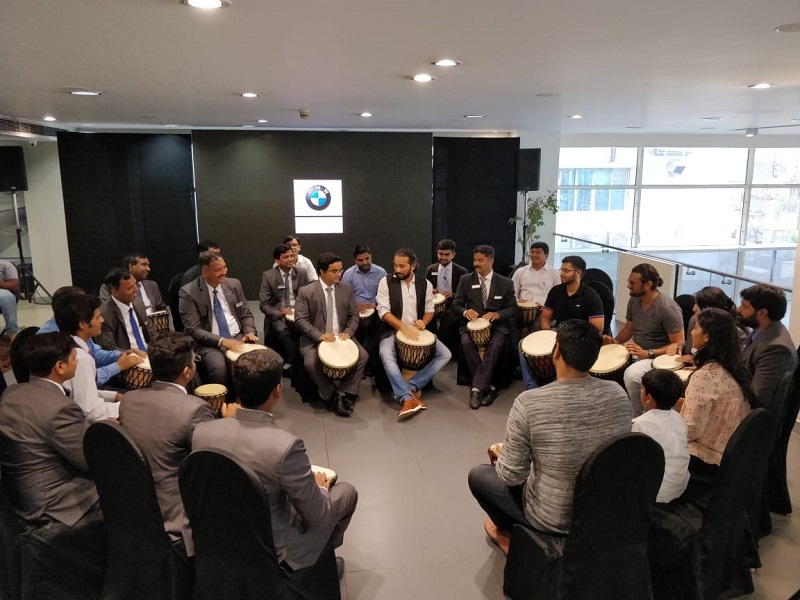
For starters, we’re an emotional bunch and love to add a bit of masala into everything, even our work lives. Today, most start-ups don’t bother with offices of their own and enjoy working from the nearest coffee shop or co-working space. We have the freedom to work from anywhere and yet we hover closest to others in a similar setting. In fact, we’ve recently seen a rise of Group Drumming inquiries at co-working spaces. This furthers our belief that whether your company has 50 employees or 500, the need to create a bond with those around you, connect with them on a non-work level helps build roots or an anchor for these people and that is what keeps a person loyal to a company (sometimes more than a handsome salary). Hence: group activities for employees or employee engagement activities in companies are the need of the hour.

More importantly, is the experience of a state of FLOW. Research says that ‘being in a state of FLOW’ is nothing but being 100% engrossed in all that you’re doing. Drumming is one such activity. While you are drumming, your conscious mind is occupied with a complex motor coordination activity and hence the subconscious mind starts being tapped into. This is our reservoir of latent potential… THIS is what we are awakening through drumming through various exercises that Taal Inc. has pioneered… Drumming in a group creates a forum to truly listen to one another because if not, you won’t be drumming with each other but AT each other.

group activities for employees by Taal Inc

So, here’s what we suggest: List down the times you’ve engaged in an activity where you’ve simply forgotten about all else for that time… Pick one activity and do it. Wake up every morning, run, chant, do tai chi, learn the djembe, bake, study the abacus, learn sign language, and engage in an act of kindness every day.

Given this background, think about it, where else will you have a safe and secure atmosphere to let go and express pent up frustration? Where else will you be able to feel the energy of drumming with a hundred people and yet the calm pulse of your heartbeat? Where else will you feel emotions fully and unobtrusively without any impending thoughts but at a Taal Inc. Drum Circle?

Are You An Art Therapist? Expressive Arts Therapy Practitioner? Arts Based Facilitator?

Today, it is more and more common to hear about, read about or attend workshops to experience the use of a particular art form to positively influence a behavioural objective (using art not only for the purpose of creating art, but more!). Art therapy, arts based therapy, music therapy, expressive arts therapy, visual art therapy, drama therapy and so on are words that are used very often and hence rather loosely too.

art therapy by Taal Inc

This article is a compilation of information from various sources and is aimed at starting a discussion about the topic of appropriate nomenclature for people working in the field of using arts modalities for health and wellbeing.

Every course that you do will (or should) have a clear description regarding its scope and application.

If you complete a university degree course in Music Therapy or Expressive Arts Therapy, then you are a Music Therapist or Expressive Arts Therapist respectively. Depending on the autonomy of the university in question, the course may be a diploma or a certificate course. In both these cases, it is mandated that the title you receive at the end of the course will be clearly mentioned and detailed out beforehand.

Apart from Universities, there are a myriad private institutions offering courses in one and or many art based modalities to be used in the field of arts for health and wellbeing. For example: NLP, Introduction to Visual Art Therapy, Drum Circle Facilitation Course, Find Your Inner Rhythm Facilitator Training Courses, Dance Movement Therapy Diploma Courses, Access Consciousness Training Courses, Hypnotherapy and so on. Now, despite the name of the workshop or course, you will not earn the title of ‘therapist’ at the end of such a privately run course. Why? Because the course design has not gone through a process as stringent as a university degree course goes through vis a vis time spent in theory, practical work, supervision, observation, internships etc. Hence, you may receive the title of ‘facilitator’ or ‘practitioner’ at the end of such courses. This would make you a

  • Visual Art Therapy Practitioner / Facilitator
  • Dance Movement Therapy Practitioner / Facilitator
  • Drum Circle Facilitator
  • Expressive Arts Therapy Practitioner / Facilitator
  • Arts Based Therapy Practitioner / Facilitator
  • Creative Arts Therapy Practitioner / Facilitator

Note that if you have done many of these more-focussed and privately-run dance, music or visual art based courses, this does not make you (as you would intuitively like to conclude) a creative arts therapist or an expressive arts therapist. In short, dance therapy + visual art therapy + music therapy ≠ expressive arts therapy. Expressive arts therapy is a whole other modality and is to be treated that way.

Seems all too wordy considering all this started with the main prerequisite being people with a strong intention of ‘healing’ through their respective medium or art form. Having said this, knowledge is power and this information does help us spread accurate, standardised and authentic awareness of what Arts for health and wellbeing is and what it is not!

Design a site like this with WordPress.com
Get started